
Drowning in Debt on a Fixed Income?
We Stop Creditor Calls & Reduce What You Owe
Tired of struggling to pay off debt while creditors won’t stop calling? We negotiate with your creditors, stop the harassment, and help you regain financial freedom—without bankruptcy.

Living on a Fixed Income and Stuck in a Cycle of Debt?
If you’re on Social Security, disability, or a limited retirement income, keeping up with mounting debt can feel impossible. Credit card bills, medical debt, and personal loans pile up while creditors won’t stop calling and demanding payments you can’t afford.
Many people in your situation experience the following:
Paying just the minimum, but the balance never decreases.
Constant phone calls and threatening letters from creditors.
Using one credit card to pay off another.
Feeling trapped with no way out.
The Longer You Wait, the Worse It Gets
Each day, interest builds, late fees stack up, and the stress of unpaid bills becomes overwhelming. Creditors don’t care about your situation—they just want their money.
What if you could:
End the harassing phone calls and letters?
Reduce your debt without filing for bankruptcy?
Take back control of your finances?
With Fixed Income Debt Relief, you can.

We Negotiate Your Debt, Stop Creditor Calls, and Save You Money
At Fixed Income Debt Relief, we provide a legal and effective solution to reduce your debt and give you peace of mind.
We negotiate with creditors on your behalf to lower your total debt amount.
We put an attorney on retainer to stop calls and collection letters.
We create a custom debt resolution plan that fits your fixed income.
We help you become debt-free faster without filing for bankruptcy.
Fill out the form below to get started today.

The Fixed Income Debt Relief Advantage

Attorney on Retainer
No more dealing with creditors. We handle them for you.
Debt Negotiation Experts
Reduce your debt and settle for less.

Stop Collection Calls
Get legal protection against harassment.

No Upfront Fees
We don’t get paid until we help you.
The Power of Attorney-Assisted Debt Relief
Not all debt relief companies provide legal support, but we do.
When you enroll in our program, you’re paired with a qualified attorney who:

Takes over all communication with creditors
So you never have to deal with them again.

Negotiates directly
To reduce the total amount you owe.
Provides legal protection
Against aggressive collection tactics and potential lawsuits.

Ensures creditors comply with the law
And do not engage in illegal harassment.
See If You Qualify for Attorney-Assisted Debt Relief
TESTIMONIALS
What Clients Are Saying

Fixed Income Debt Relief changed my life! They stopped the harassing calls and helped me settle my debt for less than I owed. I can finally breathe again.
– Diana G.


“I was drowning in credit card debt with no way out. Their team handled everything, and now I’m on a payment plan I can actually afford.”
– Jack A.

“Within weeks, the creditor calls stopped completely. I no longer wake up to collection threats, and I have a clear path to becoming debt-free!”
– Linda T.

“I was skeptical at first, but this program worked exactly as promised. I saved thousands, and they negotiated everything for me.”
– Robert P.

“The stress of debt was affecting my health. Fixed Income Debt Relief gave me my life back. The attorney on retainer was a huge plus!”
– Mary J.

“They worked directly with my creditors to reduce my total balance. I no longer feel like I’m drowning in debt.”
– Tom P.

“Every month, I was struggling just to make my minimum payments. Their team gave me a plan that actually works, and I’m finally seeing progress.”
– Betty S.

“I thought bankruptcy was my only option, but Fixed Income Debt Relief showed me another way. I’m so glad I found them!”
– James L.

“The best part was having someone else handle the creditors for me. No more stress, no more sleepless nights!”
– Nancy R.

“I wish I had called sooner. Their team was kind, professional, and truly cared about my financial situation. Highly recommend!”
– Samuel W.
Tired of creditors calling?
Want to finally break free from debt?
Take the first step toward financial relief now. Fill out the form below, and our team will contact you with a customized plan to get you back on track.
No obligation. No upfront fees. Just results.
STILL NOT SURE?
Frequently Asked Questions
1. How does your debt relief program work?
We pair you with a qualified attorney who works directly with your creditors to bring on debt resolution and take the burden off your shoulders. Instead of dealing with harassing calls, overwhelming payments, and mounting debt alone, you’ll have legal protection and expert financial assistance to guide you toward relief.
Here’s how it works:
• Step 1: Free consultation to assess your debt situation.
• Step 2: We connect you with an attorney who immediately takes over all creditor communications.
• Step 3: Your attorney works on a legal strategy to resolve your debt while ensuring creditors comply with debt collection laws.
• Step 4: You gain financial relief through an organized plan that fits your fixed income.
No upfront fees, no bankruptcy, and no more creditor harassment.
2. Can you really stop creditor calls and harassment?
Yes. Once you enroll, your attorney takes over all communication with creditors, meaning collection calls and letters must go through them, not you.
This provides legal protection against aggressive tactics, giving you peace of mind while your debt is being handled.
3. Will this hurt my credit score?
Initially, being in a debt resolution program may lower your credit score. However, as you regain control of your finances and reduce your debt burden, your financial health improves over time. Many clients see their scores rebuild faster than if they had continued struggling with high-interest payments.
4. Do I need good credit to qualify?
No. Your credit score does not affect your eligibility. Our program is designed to help people struggling with debt, regardless of their credit history.
5. What types of debt do you help with?
We specialize in unsecured debt, including:
• Credit card debt
• Medical bills
• Personal loans
• Collections accounts
• Past-due utility bills
We do not handle secured debts such as mortgages, auto loans, or federal student loans.
6. Is this program the same as bankruptcy or debt consolidation?
No. Our program is a debt resolution service, which means we work to resolve your debt without requiring court filings or new loans.
• Unlike bankruptcy, our program does not stay on your credit report for 7-10 years or require legal proceedings.
• Unlike debt consolidation, you are not taking out a new loan—instead, we work on a legal strategy to resolve your outstanding debts.
7. How much can I save with this program?
Each case is different, but many of our clients reduce their overall debt burden significantly while regaining financial stability. The sooner you start, the more relief you can experience.
8. What happens if I stop making payments to my creditors?
If you’re struggling to make payments, your attorney will work to protect you from aggressive collections and ensure that creditors are following legal guidelines. Our goal is to help you find a manageable path forward without financial strain.
9. How do I know this is legitimate?
We are a trusted debt relief service with an experienced team of attorneys and financial professionals. We have helped thousands of clients regain control of their finances. You can review our client testimonials and success stories for proof of our results.
10. How do I get started?
Getting started is simple! Fill out the form below, and a debt specialist will reach out to discuss your options. There’s no obligation and no upfront fees.
Smart Debt Solutions for Fixed-Income Earners
Struggling with debt while living on a fixed income?
Our blog provides expert insights, legal strategies, and practical financial tips to help you reduce debt, stop creditor harassment, and regain control of your finances. Whether you’re dealing with overwhelming bills, collection calls, or simply looking for ways to manage your money better, we’re here to guide you every step of the way.
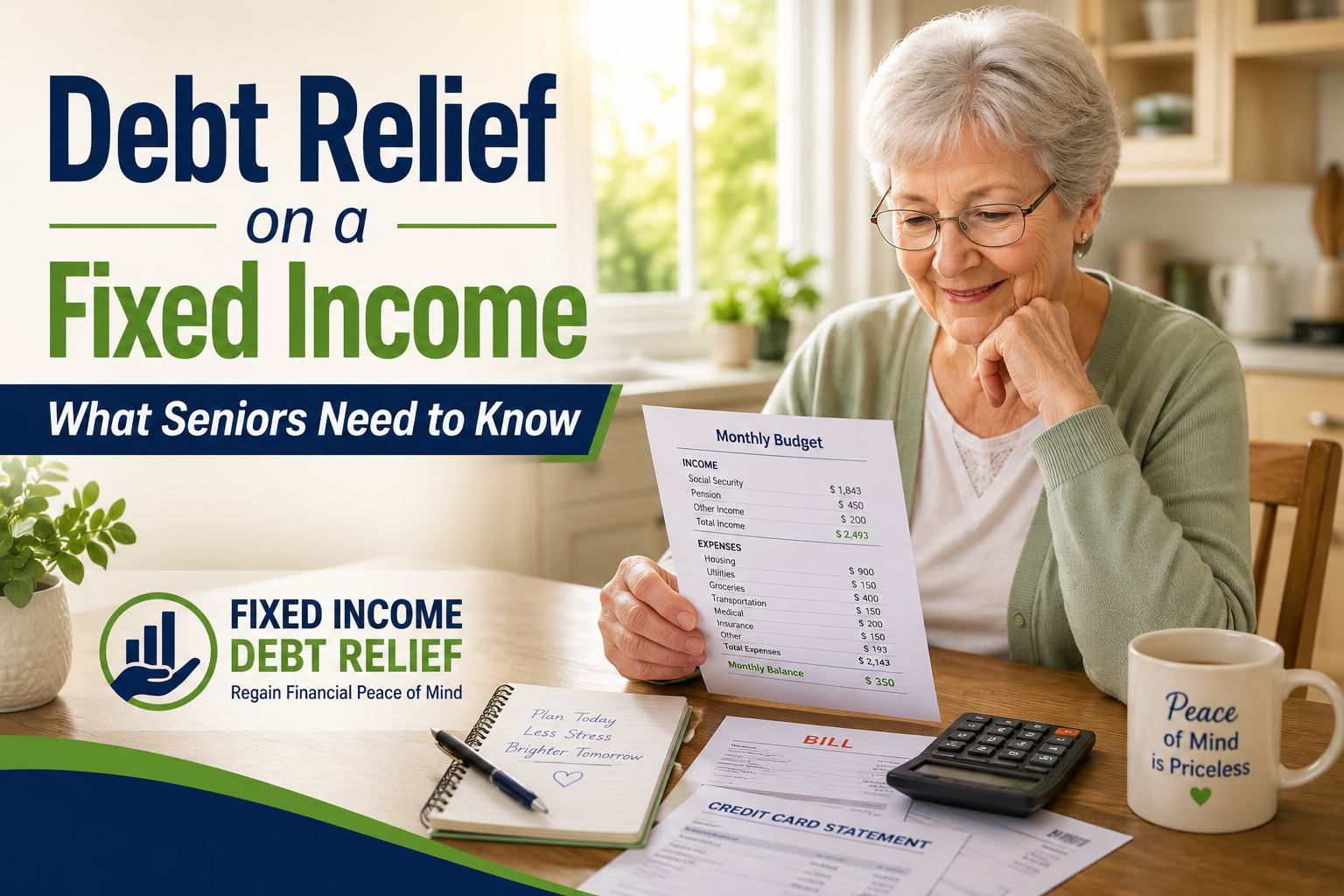
Can You Get Debt Relief on a Fixed Income? What Seniors and Retirees Need to Know
Can You Get Debt Relief on a Fixed Income? What Seniors and Retirees Need to Know
If you are living on Social Security, a pension, disability income, or a combination of retirement benefits, debt can feel especially overwhelming.
Every month starts with the same question: Will there be enough money?
Housing costs continue to rise. Groceries cost more than they did a few years ago. Medical expenses seem to appear when you least expect them. Meanwhile, credit card balances, personal loans, and old debts continue demanding payments.
Many seniors and retirees feel trapped. They believe they have only two choices: keep struggling to make minimum payments or accept that debt will follow them forever.
The reality is different.
Debt relief may be available even if you live on a fixed income. Understanding your options can help you regain control, reduce financial stress, and create a path toward a more stable future.
In this guide, we'll answer some of the most common questions seniors ask about debt relief and explain how fixed-income households can explore solutions that fit their situation.
Why Debt Has Become a Growing Problem for Seniors
Retirement is supposed to be a time when financial pressures ease. Unfortunately, that is not the reality for many Americans.
Many retirees enter retirement carrying debt from years earlier. Others accumulate debt after retirement due to unexpected circumstances such as:
Medical emergencies
Rising housing costs
Supporting adult children or grandchildren
Inflation
Reduced income after leaving the workforce
Loss of a spouse
Home repairs and maintenance costs
What starts as a manageable credit card balance can slowly become a major burden.
Minimum payments may keep accounts current, but they often do little to reduce the principal balance. Interest charges continue accumulating month after month.
For someone on a fixed income, even a small increase in expenses can create a financial crisis.
Common Signs Debt Is Becoming Unmanageable
Many people wait too long before seeking help because they assume their situation is not serious enough.
Here are some warning signs that debt may be becoming difficult to manage:
You Are Using Credit Cards for Basic Living Expenses
If groceries, utilities, medications, or gas are regularly being charged because monthly income is not enough, debt may continue growing faster than it can be repaid.
You Only Make Minimum Payments
Minimum payments often cover mostly interest and very little principal.
As a result, balances can remain for years or even decades.
You Are Choosing Between Bills
Many seniors find themselves deciding whether to pay a credit card, buy medication, or cover utility costs.
This is a major indicator that debt is affecting financial stability.
Collection Calls Are Increasing
Frequent collection calls, letters, and account notices often indicate that balances have become difficult to manage.
Financial Stress Is Affecting Your Health
Debt is not only a financial issue.
Many retirees report:
Trouble sleeping
Anxiety
Depression
Relationship strain
Constant worry about the future
When debt begins affecting your quality of life, it may be time to explore solutions.
Can Seniors Qualify for Debt Relief?
One of the biggest misconceptions is that debt relief is only for people with high incomes.
In reality, many debt relief programs are designed to help individuals who are struggling financially.
Qualification depends on several factors, including:
Amount of unsecured debt
Income sources
Ability to make payments
Financial hardship circumstances
Overall financial picture
Fixed income alone does not automatically disqualify someone from seeking debt relief options.
Every situation is unique.
What Types of Debt May Qualify for Relief?
Debt relief programs often focus on unsecured debt.
Unsecured debt generally includes:
Credit cards
Personal loans
Medical bills
Certain collection accounts
Secured debts such as mortgages and vehicle loans are usually handled differently because property serves as collateral.
Understanding the type of debt you have is an important first step when evaluating possible solutions.
Debt Relief Options for Fixed-Income Households
There is no one-size-fits-all solution.
The right approach depends on your financial situation, debt amount, income, and goals.
Here are some options that may be worth exploring.
Debt Resolution Programs
Debt resolution programs are designed to help individuals who are unable to fully repay unsecured debt under the original terms.
These programs may involve negotiating with creditors to resolve debts for less than the full balance owed.
For retirees struggling with large credit card balances, this can sometimes provide a path toward becoming debt-free faster than continuing minimum payments indefinitely.
Debt Management Plans
Debt management plans typically involve working with a credit counseling organization.
The goal is often to consolidate multiple payments into one structured monthly payment while potentially reducing interest rates.
This option may work well for individuals who can still afford to repay their balances over time.
Direct Creditor Hardship Programs
Many creditors offer hardship programs for customers experiencing financial difficulties.
These programs may provide:
Reduced interest rates
Lower monthly payments
Temporary payment relief
Alternative repayment arrangements
Many seniors are surprised to learn that these programs exist.
Budget Restructuring
Sometimes debt challenges are worsened by an outdated budget that no longer reflects current expenses.
A detailed review of income and spending can identify opportunities to free up cash flow.
Even small improvements can make a meaningful difference over time.
What About Social Security Income?
Many retirees worry that receiving Social Security prevents them from seeking debt help.
This concern often comes from confusion about how debt collection and income sources work.
The important thing to understand is that having Social Security income does not automatically prevent you from exploring debt relief options.
In fact, many individuals who seek debt assistance rely heavily on Social Security benefits.
Since every financial situation is different, speaking with a qualified debt professional can help clarify which options may fit your circumstances.
Real-Life Example: How Debt Can Snowball on a Fixed Income
Imagine a retired widow named Carol.
Carol receives Social Security and a small pension.
Several years ago, she used credit cards to cover medical expenses after a hospital stay.
At first, the balances seemed manageable.
Then inflation increased grocery costs. Utility bills rose. Prescription expenses became more expensive.
Soon, Carol was using one credit card to help pay another.
Her balances grew from $8,000 to over $25,000.
Despite making monthly payments, most of her money was going toward interest.
Carol felt embarrassed and avoided discussing her situation with anyone.
Eventually, she learned that debt relief options existed for people living on fixed incomes.
By exploring her available solutions, she was able to better understand her choices and take steps toward reducing her financial stress.
Carol's story reflects what many retirees experience every day.
Debt problems rarely happen overnight.
They often develop slowly through a series of difficult financial decisions made during challenging circumstances.
Why Many Seniors Delay Getting Help
Even when debt becomes overwhelming, many people hesitate to seek assistance.
There are several reasons for this.
Pride
Many retirees spent decades paying bills responsibly.
Asking for help can feel uncomfortable.
Fear of Judgment
Some people worry they will be criticized for having debt.
In reality, financial hardship affects people from all backgrounds and income levels.
Lack of Information
Many seniors simply do not know what options are available.
They assume nothing can be done.
Hope That Things Will Improve
People often believe the situation will eventually work itself out.
Unfortunately, interest charges can make debt grow larger over time.
The sooner someone understands their options, the more opportunities they may have to improve their situation.
Questions to Ask Before Choosing a Debt Relief Solution
Before enrolling in any program, it is important to ask questions.
Consider the following:
What Is the Total Amount of Debt?
Knowing exactly what you owe helps determine which options may be appropriate.
What Is Your Monthly Income?
A clear understanding of income helps establish realistic payment expectations.
Which Debts Cause the Most Stress?
Prioritizing high-interest accounts or collection accounts may help create a more effective plan.
How Long Will Resolution Take?
Every program has a different timeline.
Understanding expectations can help avoid surprises later.
What Are the Potential Benefits and Drawbacks?
Every financial solution involves tradeoffs.
Make sure you understand how a program works before making a decision.
Taking the First Step Toward Financial Relief
Debt can feel isolating.
Many seniors believe they are facing these challenges alone.
The truth is that millions of retirees and fixed-income households struggle with debt every year.
The good news is that options may be available.
Whether the challenge involves credit card balances, medical debt, personal loans, or collection accounts, learning about possible solutions is often the first step toward regaining financial confidence.
You do not need to have all the answers today.
You simply need to understand that help may exist and that exploring your options does not commit you to any specific program.
Knowledge creates clarity.
Clarity creates confidence.
And confidence creates the ability to move forward.
If debt is creating stress, affecting your monthly budget, or making retirement more difficult than it should be, now may be the right time to learn what solutions could be available for your situation.
Visit https://fixedincomedebtrelief.com/ to learn more about debt relief options designed for individuals living on a fixed income.


Innovation
Fresh, creative solutions.

Integrity
Honesty and transparency.

Excellence
Top-notch services.
GET DEBT RELIEF TODAY!
QUICK LINKS
FOLLOW US
